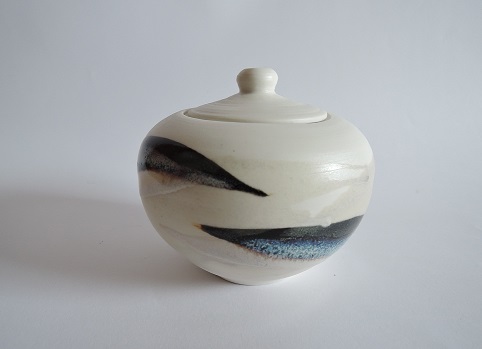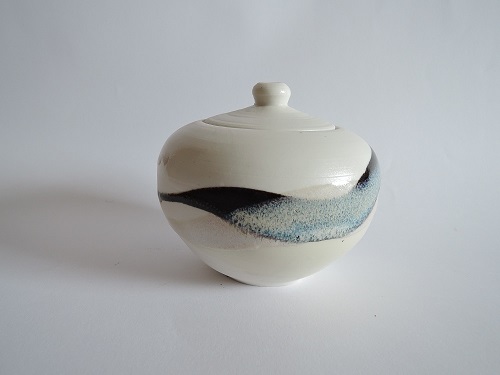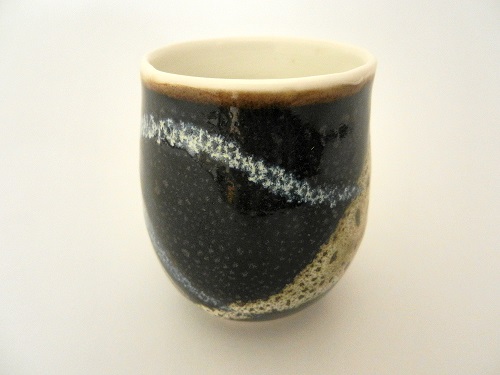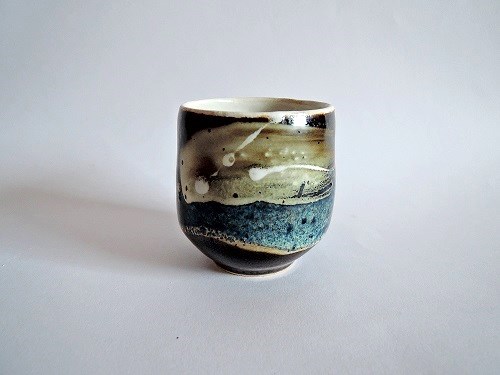
Lidded pot – Porcelain

It is always with some trepidation that I listen to friends suggesting I make something specifically for them. It all sounds innocent enough, they’d perhaps simply like to have a few more goblets to add to some earlier ones of mine they already have, and while I’m at it, why not a sugar bowl with a matching glaze decorative touch, and, pushing their luck a little, also a milk pitcher?

I wasn’t pleased with my first attempts, but my friend seems happy with this piece (I call it a lidded pot, she calls it a sugar bowl), but she will have to wait some time still for anything like a milk pitcher (I have a few waiting for bisque firing, and, if successful, they will be the subject of an upcoming post).

Below you see the other side of the piece:

lidded jar-wider top-front-3xresizedDSCN4250

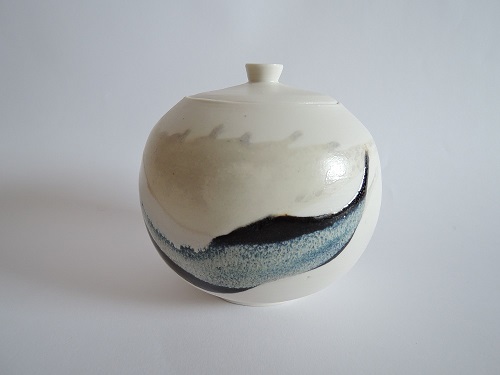
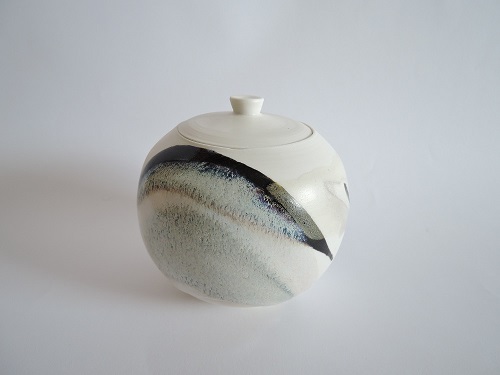
Here’s another one I made, something like a lidded moon jar.

In both cases, decoration with three squirts of glaze, where a white turns blue over the dark tenmoku.

Transparent glaze inside (poured), and a light coating all over the outside  (spray-gun).

lidded jar-round-back-3xresizedDSCN4247

Second side:

lidded jar-round-front-3xresizedDSCN4246

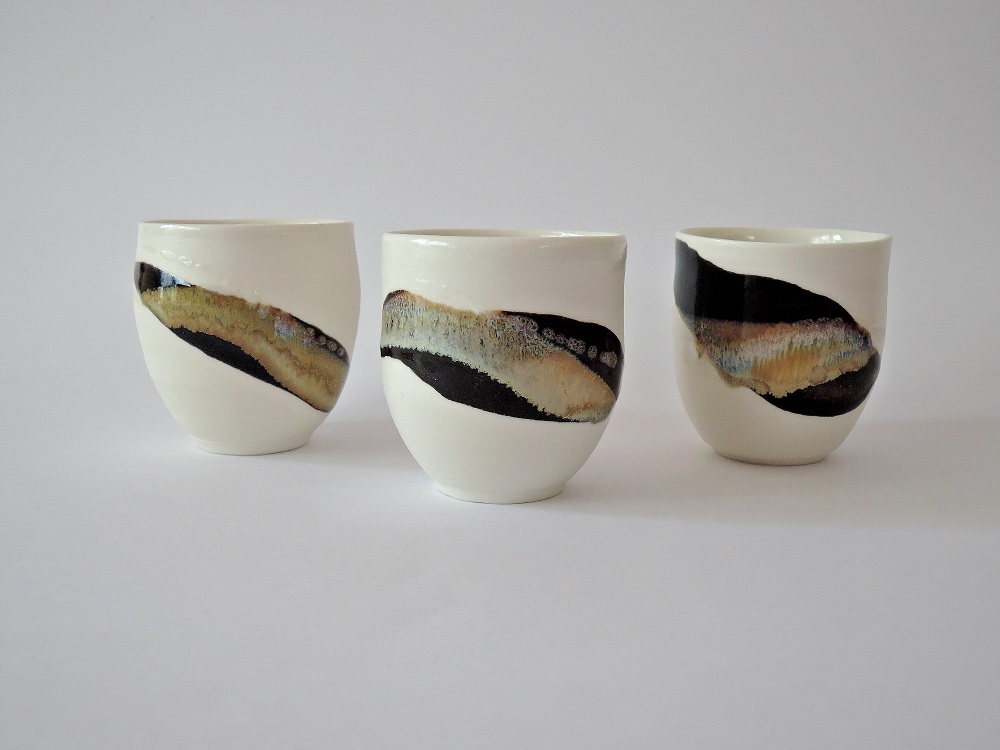
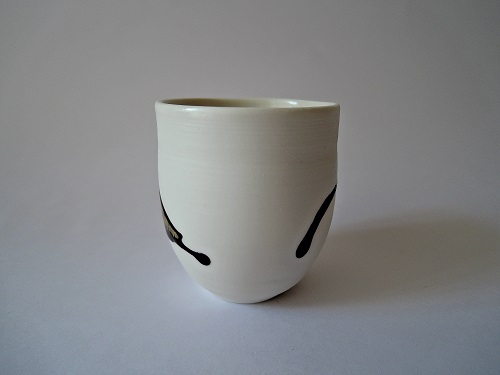
Goblets – caramel chocolate


I seem to have moved on to lidded pots, but still the goblets continue. Here again, tenmoku, overlaid with the zinc white 66. I’ve been making sets of six, each goblet in the set of similar shape and size,  with splashed glazes linking them together. I quite like the stark glaze drips at the back; however, some (who shall remain nameless) tell me the back should be less obviously a back, and also be a front (I think). I’ve been working on the idea, and the next lidded pots (awaiting a glaze kiln fiting) have an additional upside-down splash here. I was not entirely successful in making the splash ‘fit’… I will keep you posted.

Ht: 7.5 cm; di: 6.6 cm.

GobletCaramelChocolateBackFSCN4065

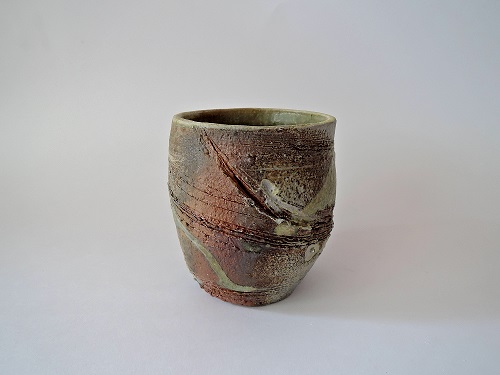
Anagama kiln – Small vase


Anagama kiln, five-day wood firing.

Heavily grogged, white stoneware clay.  Celadon inside, and a splash on the outside.

All the other tones are the natural effect of the swirling ash in the kiln.

Ht: 10 cm.; di: 8.5 cm.

Below, reverse and side view.


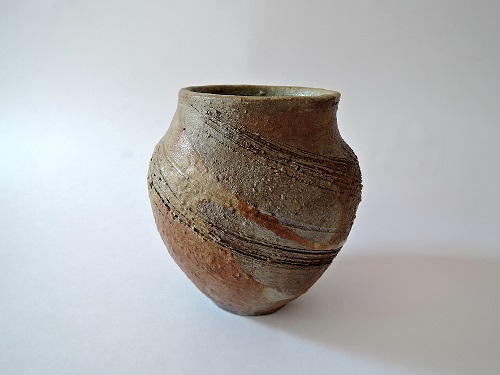
Anagama – Wood-fired vase


Five-day firing, at Arlette’s, out towards Arlon. Logs loaded regularly, day and night, anxiously watching the temperature gauge, as it moves towards 1300°C. Thanks to Alain, who was on the kiln team. The kiln is large, many potters contribute their pieces – the spread in the field is about half the kiln load (see above).

I used a heavily-grogged, white stoneware clay; I first pulled up a cylinder, and combed it while wet; then opened it out further, to get its rounded form. Angling the pot, I squirted one splash a celadon on the neck, letting it run down to the bottom, back (see below). Celadon poured on the inside. All the other colours are the magic of the ash glazes swirling in the atmosphere of the kiln, and then falling randomly on my piece.

Ht: 14 cm.; di: 12 cm.

Back view (at bottom).

AnagamaMarch2016-BackFSCN4026 AnagamaMarch2016-SideFSCN4027

Lidded Pot – Silver Cloud

Moving to rounded, lidded porcelain pots. Trying to keep them light, and to find the right lines, first for the shape of the pot, then for its close-fitting lid. Hoping for a steady hand, I try to make the squirts of glaze emphasize that line. A squirt of thick tenmoku first, then, when it has partially dried, I partially cover it with a watery squirt of a tin-white glaze. Finally, a fine covering of transparent 51, using the spray gun.

Fired in oxidation, to 1250°C


Below, close up: Silver Cloud


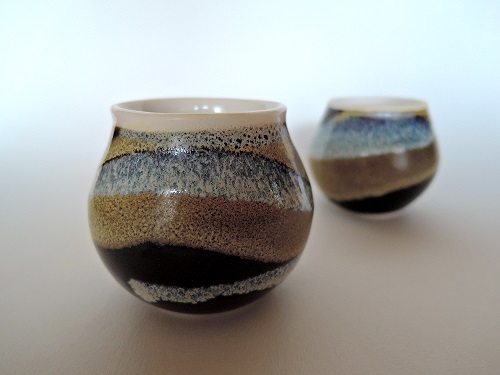
Mini vases, porcelain: Storms River

Results from another kiln firing.Instead of laying a jet of tenmoku down and leaving most of the porcelain visible as I was doing in my earlier series, here I am using it as the base glaze all over the outer surface. However, I highlight the porcelain by leaving a margin of white at the base and at the top by using latex on those edges, and only then dipping the pot into the glaze. Next I lay down a squirt of white, followed by a rutile-baded glaze, giving the blue. Transparent glaze over the rim and down the inside. Fired to 1260°C; height: 6-7 cms, diameter slightly greater than height.

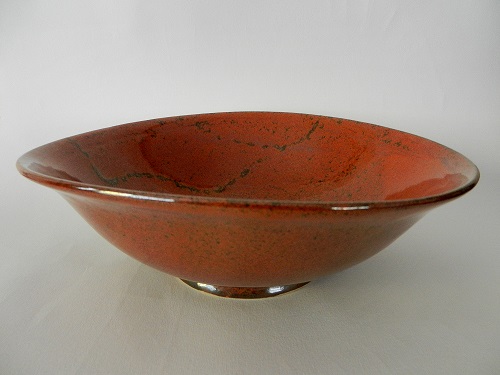
Orange-red bowl – distorted

I am still working on how to consistently get this gorgeous orange red. This is a potash feldspar/bone ash glaze with additions of iron oxide, as Michael Bailey sets out in his book Glazes, cone 6, 1240°C. He shows the gradations of colour obtained by increasing the amount of iron oxide by 1% each time.

Of course, there is always more to it than meets the eye. I’ve managed to get some wonderful results on test pieces, using 6%, 8% and 12%, but they don’t replicate on full-size pots, at least not consistently and not both inside and outside… Sometimes a thin layer of glaze is bright and successful, but when I actually dare to use on a piece, it’s all rather disheartening: often it comes out of the glaze kiln a dirty brown. And since I use shared workshop space with others, I am limited to the kiln temperature used by the group, 1260°C (so considerably higher than the specified cone 6).

Starting again this month, I have gone back to another workshop, where my former maître, Alain Losa, is teaching. They fire at 1250°, so closer to cone 6. I’m hoping that by re-doing my tests, measuring the specific gravity of the glaze, and picking his brains, I can make this work. People like orange-red, so if at first you don’t succeed…

So, you may be asking, how did you manage to get this glossy orange-red?

Luck. I refired the inside of this distorted (not bad, but in my opinion dirty brown) bowl a couple of weeks ago, recoating the inside with an orange-red at 12% iron oxide (I’d used 8% the first time). I did nothing to the outside, as it was pretty good as it was. I’m happy this time.

Fired in oxidation, to 1260°

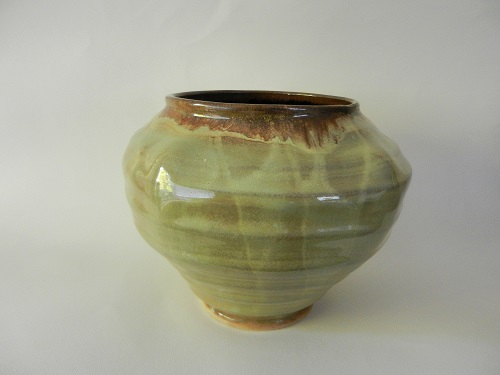
At The Pond : ridged stoneware vase, distorted (ht: 17cm, w 21cm)

This is a vase which I made a while ago, but that I never got around to posting. I will do so now, as I am going to miss it: it is going to a new home.

It was quite intriguing to make: I threw a cylinder, then opened it out. I let it dry a bit, but to less than leather-hard. Centering it back on the wheel, I used my index finger to make the grooves/ridges. Then, standing and leaning over it, I used one hand on the inside only (I couldn’t touch the outside without damaging the surface) to force the clay out, and up, five times, each hand movement creating a  raised bump on the shoulder as it came to the finish.

After bisque firing, I glazed it. First, I poured an iron-rich tenmoku glaze into, and back out of the vase, leaving a good thickness extending over the rim. After having left it to dry, I poured  T14 (a Michael Bailey transparent base glaze) over the whole piece twice, giving the varying depths and movement of the glaze as it flowed over the ridged surface. The greeny-yellow tint comes from additions of nickel, titanium,and tin oxides.

It makes me think of a pond in springtime, sunshine over murky water, rimmed with mud.

Fired in oxidation, to 1260°C

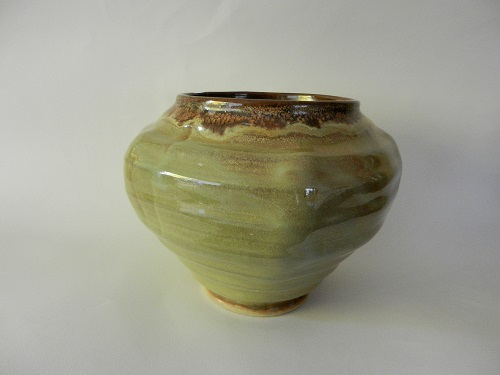
Reverse:reverse-ridges-distorted-yellowy-green-vaseFSCN3017


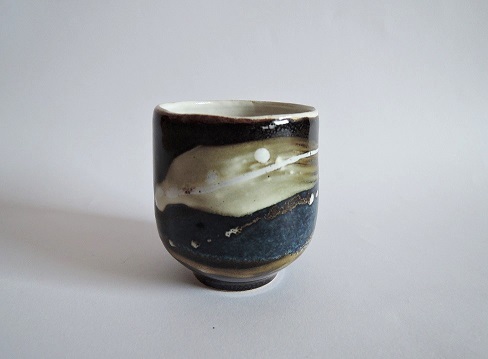
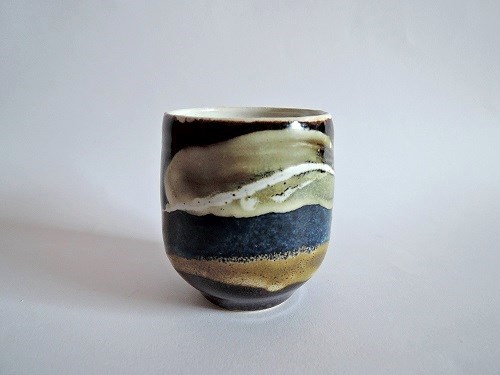
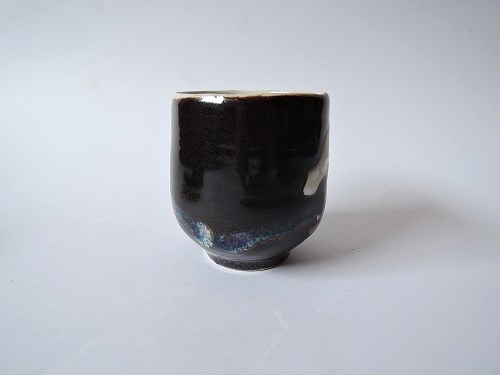
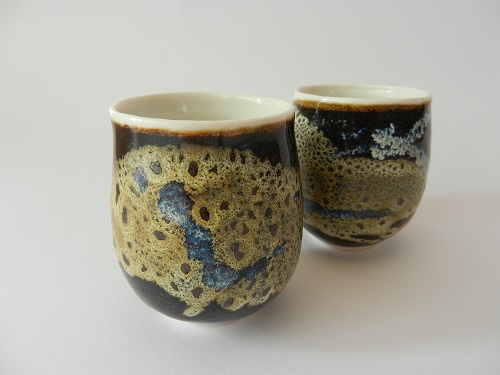
Goblets, On the Wild Side 2; ht: 8cm, di at rim : 6cm. Porcelain.


On The Wild Side 2 reverse, smallFSCN2695I wanted to cover the outside in the dark tenmoku (DMM4), but leaving some porcelain visible, emphasizing the porcelain body. I poured transparent 51 on the inside, then, after dipping the rim into the same glaze and leaving it to dry, I dipped the rim into latex. With latex also on the bottom, I dipped the goblet into the DMM4, holding from the rim. Then a big squirt of DMMH2 from a wide-nibbed bulb, followed with a couple of thin squirts of 11A. Thanks to Daniel de Montmollin and Carol Youngner for the glazes.

Fired to 1260°C, in oxidation.