Squid


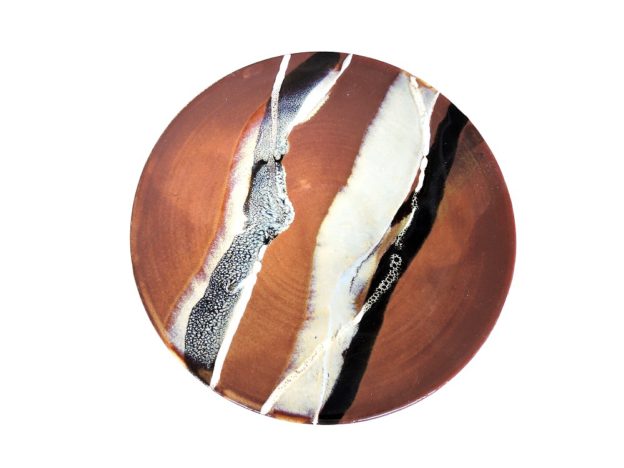
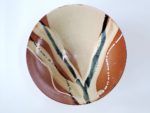
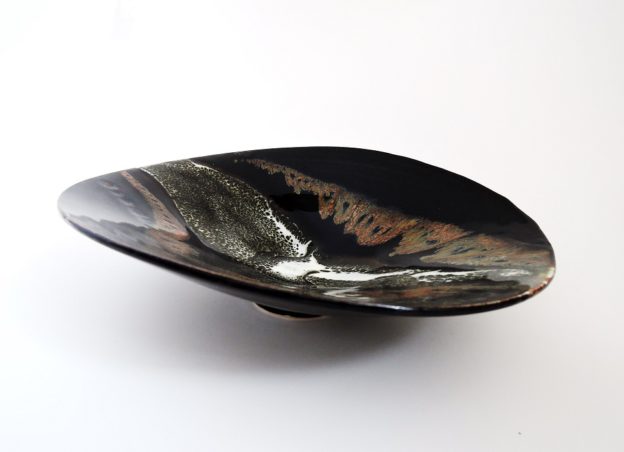
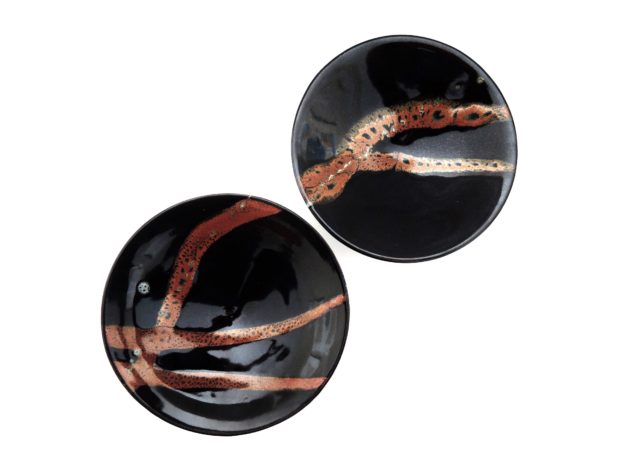
This orange-red glaze, with its 14% iron oxide, seems to love slip-sliding down the uneven slopes of this distorted bowl. This close-up shows the wide range of colours produced as this glaze runs through and over the first, deep black glaze. I love how the red turns to  greenish tan at all points where the red pulls away from the black, even around all the black pools where the black has somehow forced its way through to the surface.

The white was simply poured down the length of the bowl, between the squirts of orange-red, as I held it tilted downwards in my hand.  This glaze also breaks up nicely over the black.

Stoneware, thrown. The bowl is distorted by gently, but forcefully squeezing the sides inwards, once the piece has been trimmed, but is still damp.

Fired in oxidation to Cone 6.

Dimensions: di: 24/23 cm; ht: 5.5 cm/7 cm

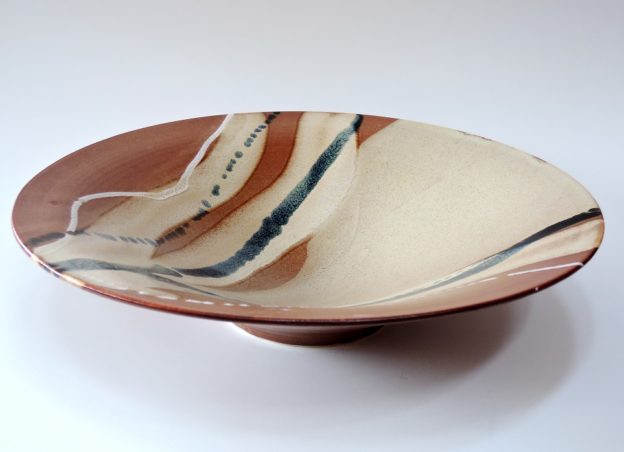
Pebblestones

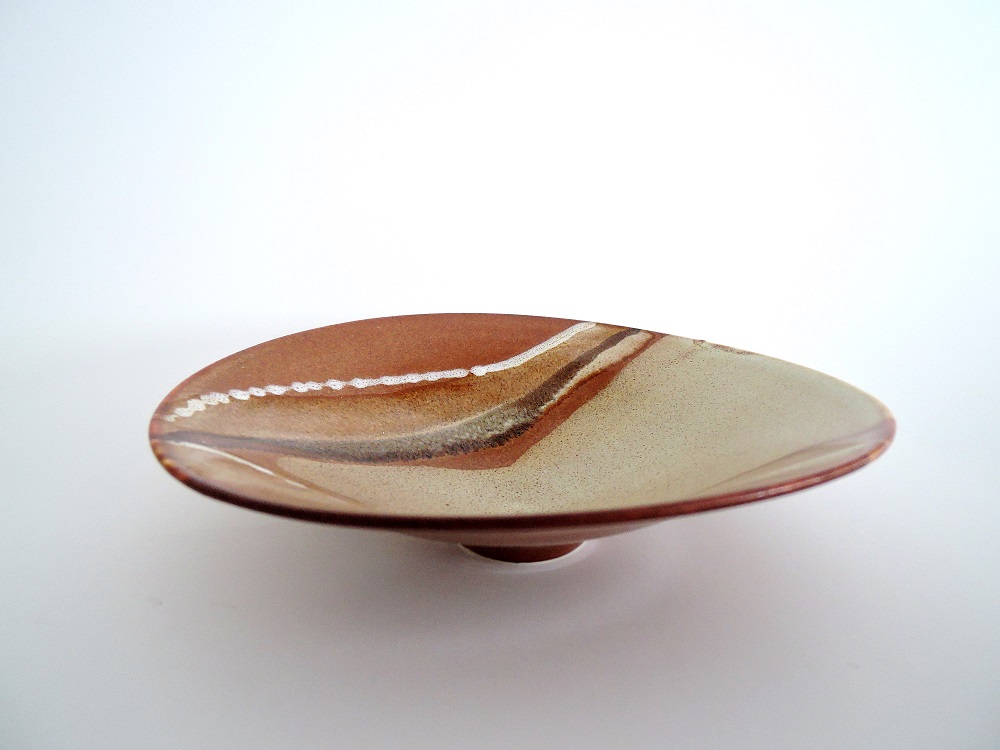
Another open, v-shaped bowl, with  the orange-red trails speckling nicely over the iron-rich base glaze. Small,  14 cm diameter. I’ll see how this glaze flows over a rounded-shaped vase next, and then, hopefully, over a large, open dish. The cone 6 firing was a little hotter this time. I’ll have to see whether this result becomes regularly repeatable…

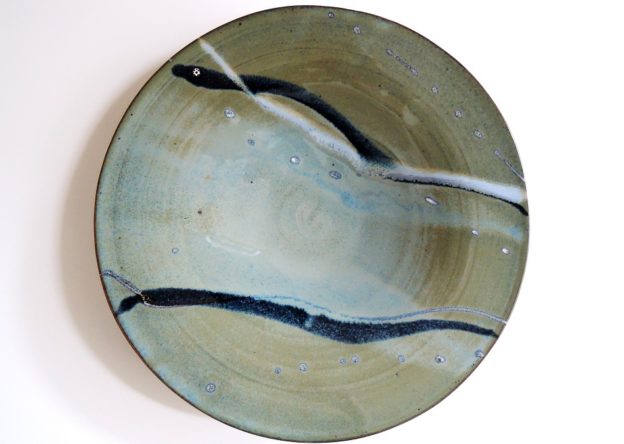
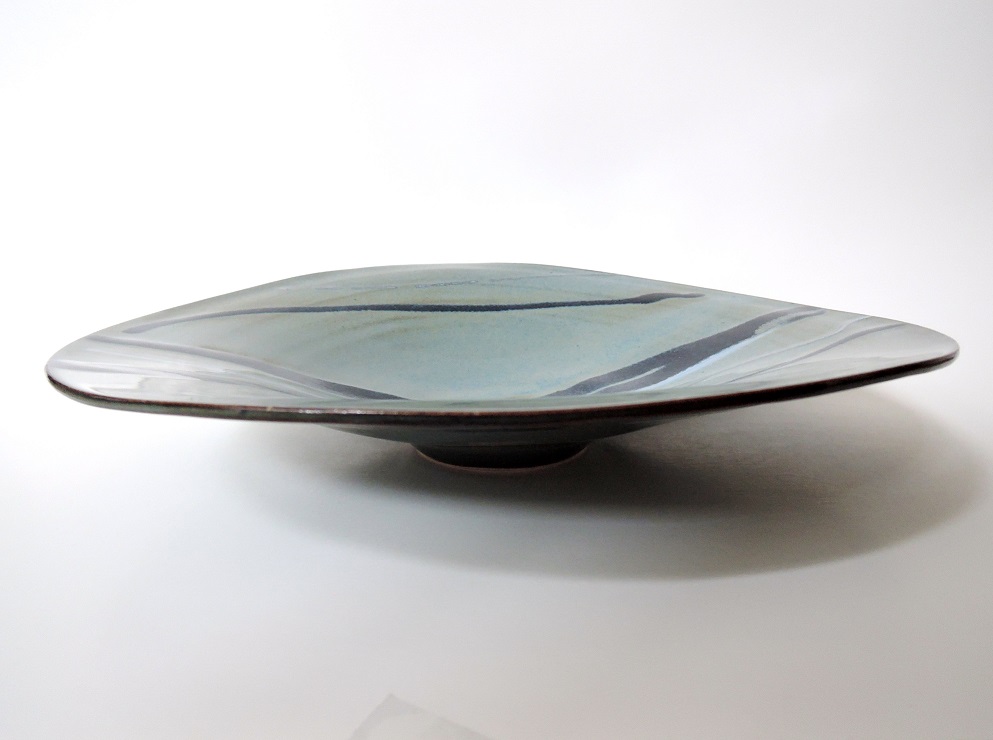
Shoreline

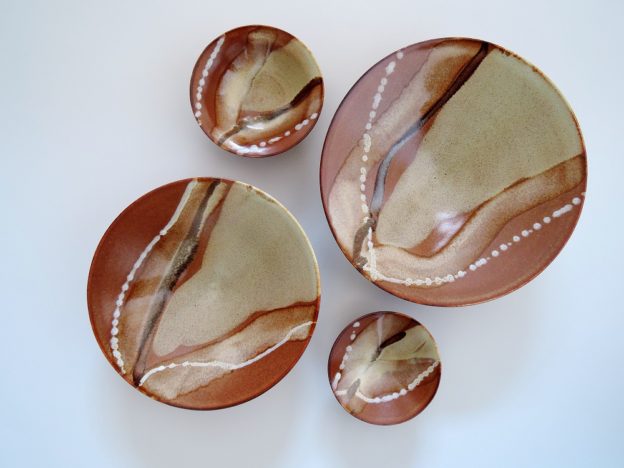
I’ve been making distorted bowls for some years now; what varies is the size, the degree of distortion, and of course the glazes I use. I started making them after my first ikebana teacher, at her home in the outskirts of Brussels, showed me a cupboard where she kept her favourite vases. These Japanese vases she took out were all lovely, but I was particularly struck by a wide bowl with its sides seemingly distorted inwards and upwards, creating a lovely wave-like effect.

What I aim for is a bowl you’d want to hold lightly in the hand, twisting it round and to catch sight inside of the coloured trails of glaze drawing your eye to the wave-like rim.

Making them myself revealed a number of challlenges. Pushing the walls of a bowl inwards after it has been trimmed is tricky: the rims at the two narrower ends are inclined to crack, as is the part near the angle at the foot, if it is trimmed thin. Under the pressure of the hands, the sides of the base may also lift, so the bowl no longer stands flat on its trimmed foot. And the squirts of glaze don’t always create the pleasing line I want.

Those problems I have learned to cope with. But in the case here of the two larger bowls, which I distorted, they show little sign of it after firing. I can only think that my recent efforts at making lighter pieces, with thinner, more carefully worked walls, has meant that the walls give in more easily to clay memory (the tendency of clay to return to its earlier, unfired, shape), and to gravity, during firing.


Dimensions:

dia: 21/22 cm, ht: 5.5 cm;
dia; 18.5/19.5 cm, ht 5 cm;
dia: 11 cm, ht: 5.5 cm
dia: 9.5 cm, ht 4 cm

Porcelaneous stoneware, fired to cone 6, in oxidation.
 

Three pharmacy jars

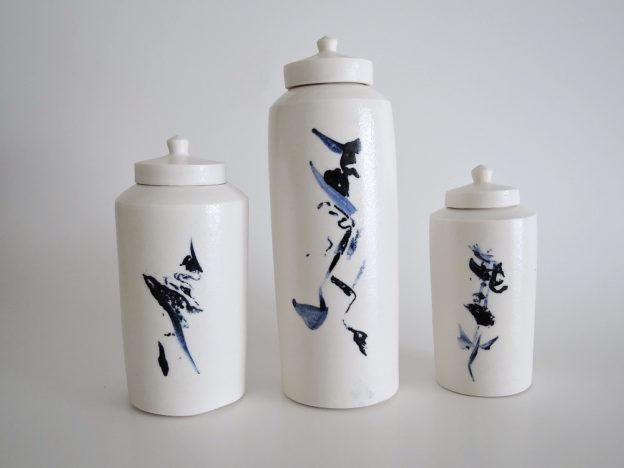
This is a return for me to work started in Brussels two years ago, using the striking, age-old combination of cobalt oxide on pure white clay. Perhaps influenced by the 17C Delft tiles and the Portuguese azulejos I am familiar with, I have tried to use the same colours to create a light, modern, impressionistic design.

The first challenge was to throw the cylinders as thinly as I could, as the effect of the design is lost if the piece, once finished, feels heavy in the hand. The second challenge was to design appropriate thrown lids that fit well. In this second set of jars, I made the cylinders narrower, improving the relationship between their height and width. Also, I realized the lines here must be straight, and that the top diameter of the cylinder must be the same, or smaller, than that of the base. Finally, the clay surface must be as smooth as possible, with all distracting trimming lines removed.

Once bisque fired, I carefully apply seemingly haphazard smudges to the bisque-fired surface, while making sure no fingerprints inadvertently stain the white surface Then I complete the design by painting the final lines using varying intensities of the diluted cobalt wash. I then quickly pour a transparent glaze over the inside surface, and out again. Finally, I lightly spray the outside using an atomiser. I keep the glaze quite thick, to get a slightly pebbled texture to the outer surface.

Dimensions:
ht 19 cm, dia 6.5 cm;
ht 14 cm, dia 6 cm;
ht 12 cm, dia 5 cm
Clay: Frost, cone 6 porcelain fired to cone 6, in oxidation.
Cobalt oxide (with Gerstley borate) applied to bisqueware, front and back.

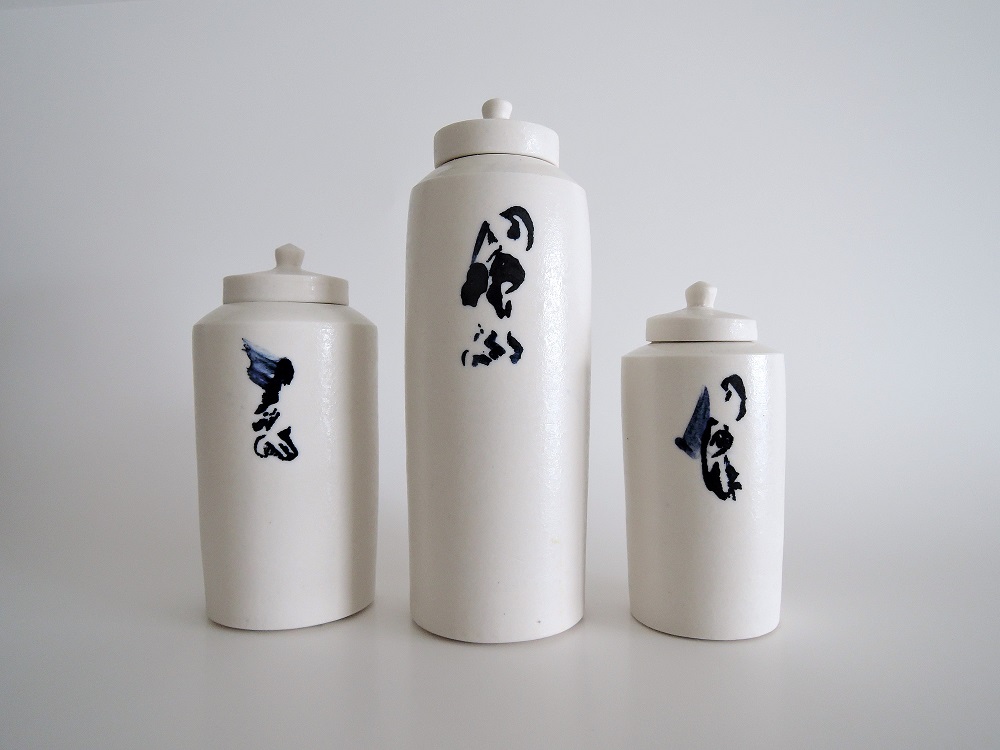
Reverse view, below:

Populace Vases – Populace at Home Exhibition at Dust Evans Gallery, Shenkman Centre

The Ottawa Guild of Potters’ Populace sculpture garden at the Canadian Museum of Nature, Ottawa (celebrating Canada’s 150th year) has now been taken down, and the roses, fleur de lis and feathers have been on show at the Dust Evans Gallery, Shenkman Centre. A number of us made vases used to display the sculptures. Below: these are my contribution to the continuing Populace story. A light dusting of glaze gives the surface a pebbled effect.

Featured image:

Stoneware, thrown. Ht:  10.6, 9.1, 8.7, and 10 inches. Base dia: 3.3

Optional perforated lids nestle inside the distorted rim

Below:

Stoneware, thrown. Ht: 10.8, 10.4, 9.2; dia at base: 3.5 inches